The fastest way to blow a bulk windbreaker order is to split the sizes evenly. An organizer orders equal counts of small through 2XL, feels fair about it, and ends up with a pile of unworn smalls and a waiting list of people who needed a large or an extra-large. Real orders are not evenly distributed, and windbreakers add a wrinkle that t-shirts do not: they are worn as an outer layer, so the fit math has to leave room for what goes underneath. Here is how to spec a size run that lands, whether you can collect everyone’s size in advance or have to estimate.
Start from a real distribution, not an even split
If you can collect actual sizes, do it, and this whole problem goes away. A simple order form that asks each recipient for their size, ideally with a link to the garment’s chest-measurement chart, beats any estimate. When that is not possible, because you are ordering ahead of a headcount or for walk-up giveaways, start from a published distribution rather than guessing. Across general mixed-adult groups, the numbers are remarkably consistent: Large is the single most common size at around 30 percent, Medium sits close behind in the mid-to-high twenties, Extra-Large is about 20 percent, and Small, 2XL, and the extremes fill in the rest. Two independent breakdowns land within a few points of each other, which is why the curve below is a safe default to build from.
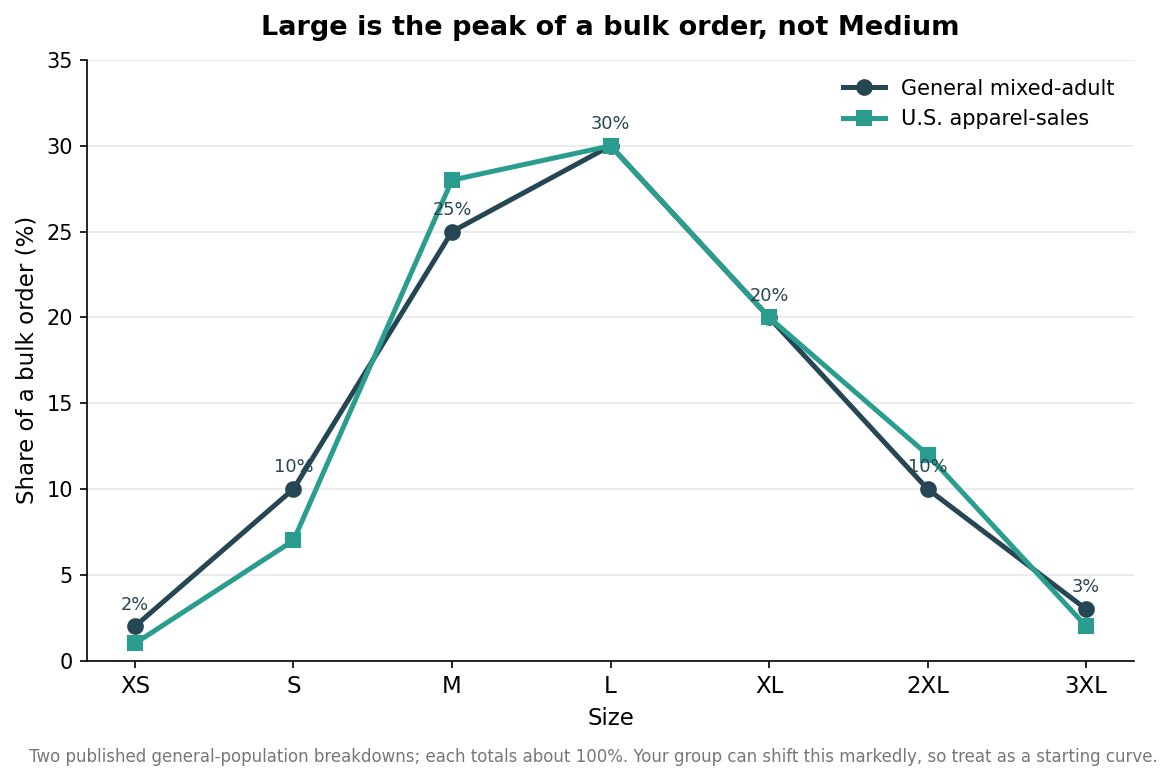
The practical takeaway is that Medium through Extra-Large accounts for roughly three-quarters of a typical order. Those three sizes are where you concentrate your quantity, and they are also where a small buffer pays off, because last-minute additions almost always want one of them. Ordering equal counts across the board overspends on Small and starves Large and Extra-Large, the exact opposite of what the demand curve says.
Adjust the curve to who is actually wearing them
The general curve is a starting point, and your group can shift it hard. A corporate or office group tightens toward the middle, with Medium through Extra-Large taking an even larger share and fewer orders at the extremes. A sports team or a trades crew skews noticeably larger, pushing Large, Extra-Large, and 2XL up and thinning the smalls. A college group, a sorority, or any predominantly female audience moves the other way, with Small and Medium taking the largest shares. If you know the group, adjust before you order: move five to ten points of quantity in the direction your audience leans and pull it from the tail you know you will not use. This single adjustment prevents most of the leftover-and-shortage problem, and it costs nothing to make on paper.
Unisex, women’s, and the layering-room problem
Windbreaker fit is where a distribution alone is not enough. Most bulk windbreakers are cut unisex, which in practice means they follow men’s proportions: broader in the shoulder and straighter through the body. Women ordering a unisex jacket frequently size down one step from their usual, and a group with many women is better served by offering a women’s cut where the blank is available rather than forcing everyone into unisex. Always distribute the actual chest-measurement chart, because windbreaker sizing runs by chest circumference and a “Large” varies between styles.
Then account for the layer. A windbreaker is an outer shell, and people wear it over a t-shirt, a hoodie, or a fleece. If it is meant to go over a mid-layer, either choose a relaxed or roomy cut or nudge the whole order up by a size for the people who will layer heavily. A jacket that fits perfectly over a bare t-shirt will feel tight over a sweatshirt, and a tight windbreaker gets left on the hook. When in doubt, err toward a touch more room; a slightly loose shell reads as intentional, a tight one reads as a mistake.
A quick ratio when you have no data at all
When you truly cannot collect sizes and do not know the group, a simple ratio gets you close. A widely used rule of thumb is 1-2-3-3-1 across Small, Medium, Large, Extra-Large, and 2XL, which scales cleanly to any quantity: multiply each number by the order size divided by ten. For a hundred jackets that yields the run below. Notice that it deliberately skews larger than a strict statistical distribution, weighting Extra-Large as heavily as Large, and that is intentional insurance, because running out at the top of the range is the failure that leaves people without a jacket.
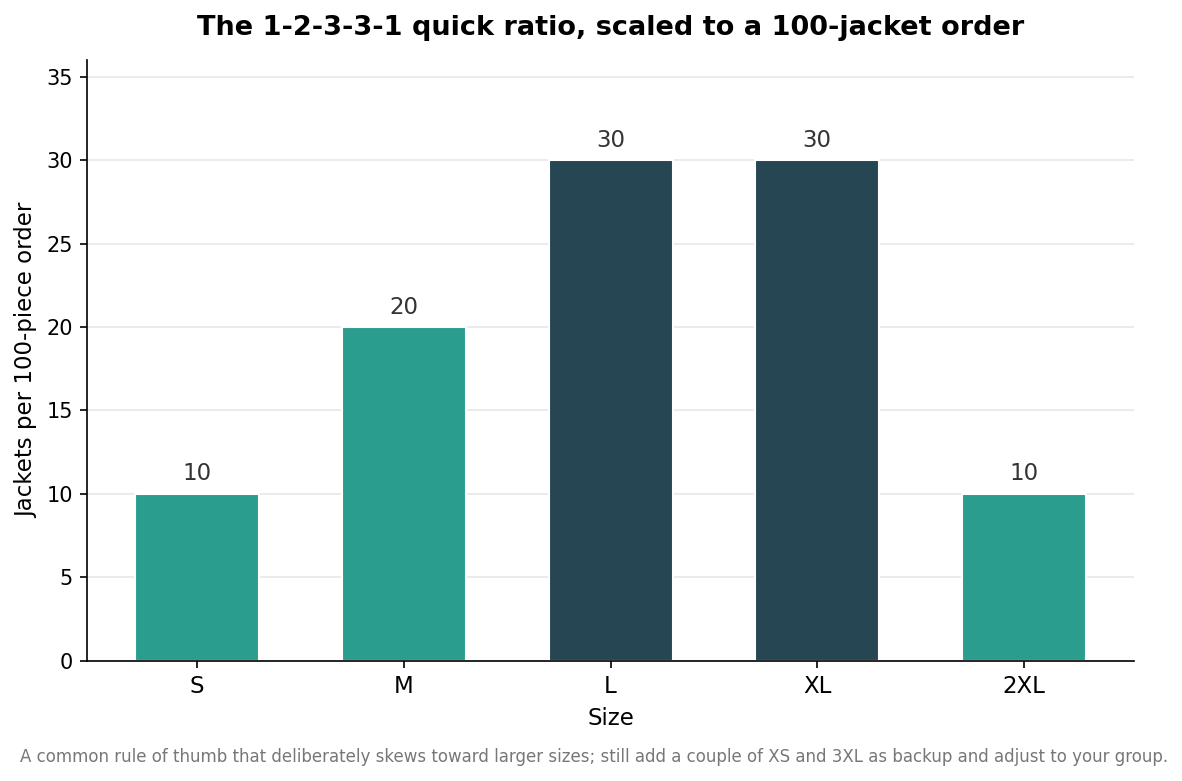
Treat the ratio as a floor rather than a complete order. It omits the extremes entirely, so add a couple of units of Extra-Small and 3XL as backup even though they will not fit the tidy pattern. The ratio is there to keep you from the even-split mistake, not to replace knowing your audience.
Overage, backups, and the size-up rule
Two rules keep an estimated order from going wrong. The first is to round up on the extended sizes rather than down. When your percentages produce a fraction, give the extra unit to 2XL or 3XL, because those are the sizes people cannot substitute their way out of if you run short. The second, and more important, is the size-up rule: someone who normally wears a Medium can wear a Large or even an Extra-Large in a pinch, but a person who needs a 2XL cannot squeeze into a Large. Because substitution only runs one direction, any uncertainty should be resolved toward the larger size. Build in a modest buffer of a few extra jackets in Medium and Large to absorb late additions, keep one or two of the extreme sizes on hand as backup, and you have an order that dresses the whole group without a box of unworn smalls at the end. Collect real sizes when you can, lean on the distribution when you cannot, and let the size-up rule settle every close call.